Course resources
Transportation of Dangerous Goods (TDG) Road
Free job aids for drivers, shippers, receivers and dock staff who handle dangerous goods on Canadian roads. Keep this page handy after your TDG course, or print it for the cab.
Is it dangerous goods? A quick flowchart
Work down from step 1. Classifying the goods is the consignor's (shipper's) job, so ask them when in doubt.
1. Has the consignor classified it as dangerous goods?
Look for a UN number and class in section 14 of the SDS, on the shipping document, or on the labels and placards.
No TDG rules don't apply to this shipment. WHMIS and your site rules still do.
Yes Go to step 2.
2. Is it shipped under an exemption or special provision?
For example, limited quantities or the 150 kg gross mass exemption in Part 1 of the Regulations.
Yes Follow every condition of that exemption. Exemptions remove some requirements, not all of them, and only while every condition is met.
No Go to step 3.
3. The full TDG requirements apply
- Classification: UN number, shipping name, class, packing group (Part 2)
- Shipping document travels with the load (Part 3)
- Safety marks: labels, placards and UN numbers (Part 4)
- Right means of containment, filled and closed properly (Part 5)
- Everyone handling, offering or transporting it is trained and certified (Part 6)
- Emergency Response Assistance Plan, if one is required (Part 7)
- Releases are reported (Part 8)
4. Something goes wrong?
Go to what to do in an emergency.
The nine classes
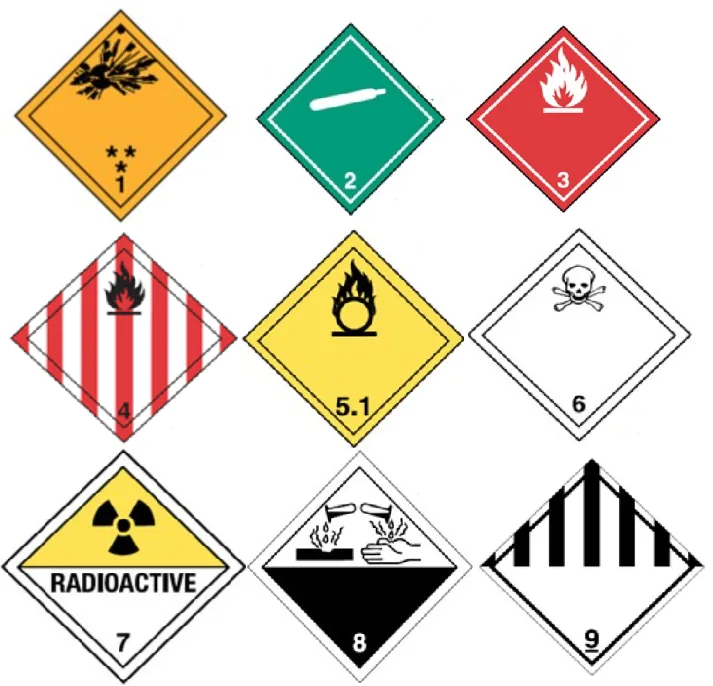
| Class | What it is | Common examples |
|---|---|---|
| Class 1 | Explosives | Fireworks, ammunition, blasting caps |
| Class 2 | Gases | Propane, oxygen, acetylene, aerosols |
| Class 3 | Flammable liquids | Gasoline, diesel fuel, paint thinner |
| Class 4 | Flammable solids; substances liable to spontaneous combustion; substances that emit flammable gas on contact with water | Matches, sulphur, sodium metal |
| Class 5 | Oxidizing substances and organic peroxides | Pool chlorine, hydrogen peroxide |
| Class 6 | Toxic and infectious substances | Pesticides, medical samples |
| Class 7 | Radioactive materials | Nuclear density gauges, medical isotopes |
| Class 8 | Corrosives | Battery acid, sodium hydroxide |
| Class 9 | Miscellaneous products, substances or organisms | Lithium batteries, dry ice |
Packing groups
Many dangerous goods also have a packing group, written in Roman numerals: I is high danger, II is medium danger and III is low danger.
Shipping document checklist
The minimum information Transport Canada requires on a shipping document.
- Consignor's name and address in Canada (or the importer's, for imported goods)
- Date the document was prepared or given to the carrier
- For each dangerous good, in this order: UN number, shipping name, primary class, subsidiary class(es) if any, packing group if any
- Quantity, in SI units such as kg or L
- Number of small means of containment (450 L or less) that need labels, for each shipping name
- The words "24 Hour Number" and a phone number where someone can be reached right away
- Consignor's certification, with the name of the person making it
- When required: ERAP reference number and phone number, and any special instructions
Where the driver keeps it
In the cab
Within the driver's reach, or in a pocket on the driver's door.
Away from the cab
In a place anyone getting into the cab can clearly see, such as the driver's seat or the door pocket.
Driver check before you leave
- Shipping document matches the load and is within reach
- Labels and placards are correct, clean and visible on all required sides
- Load is secured and containers aren't leaking or damaged
- Your TDG training certificate is with you, on paper or on your phone
- You know the 24 hour number on the shipping document and the CANUTEC number
Your TDG training certificate
- Your employer issues it once they are satisfied you are trained for your duties. Self employed people issue their own.
- For road transport it expires 36 months after it is issued. Retrain before then to keep working with dangerous goods.
- Show it right away when a TDG inspector asks for it.
- Until you are certified, you may only work under the direct supervision of a trained person who holds a certificate.
- Your employer keeps a copy and your training record until two years after the certificate expires.
What to do in an emergency
- Get yourself and others to a safe distance, upwind and uphill.
- Call 911 or the local police or fire department.
- Call the 24 hour number on the shipping document.
- Report the release or anticipated release as Part 8 of the Regulations requires. Your employer's procedures will tell you who reports.
Official rules and help
The law is in the official text. These are the sources we used and the places to check for changes.
- Transportation of Dangerous Goods Regulations (SOR/2001-286)The full regulations, Parts 1 to 17 and the Schedules
- Transportation of Dangerous Goods Act, 1992
- Transport Canada: Required information on a shipping document
- Transport Canada: Part 8, reporting requirements
- Contact CANUTEC 24 hours a day
- Transport Canada: Safety awareness materials and FAQ
Read more from Gardril
These job aids summarize the rules to help you on the job. They do not replace the official text, your employer's procedures or the training your employer gives you for your site. Content last checked against the official sources on October 22, 2026.